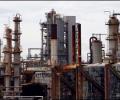
As on December 31, government stake in IndianOil stood at 78.92 per cent.
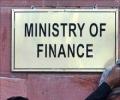
An announcement has barred the entry of journalists in the finance ministry.

Kailash Gahlot was divested of the Law and Justice portfolio in the Aam Aadmi Party government on Friday, a day after Lieutenant Governor V K Saxena recalled files related to judicial infrastructure and administration in New Delhi as they remained pending with him for months, officials said.

Pressure on the government increased with the Reserve Bank of India's surprise move on Thursday to cut interest rates
The Dipam will work under Finance Ministry.
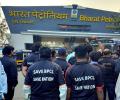
The divestment of Bharat Petroleum Corporation (BPCL) may hit a fuel price hurdle, according to officials dealing with the matter. They pointed out that the inconspicuous administered price regime could hamper the prospects for potential buyers of BPCL. A senior oil ministry official said public-sector oil-marketing companies (OMCs) take a hit when they sell petrol, diesel, and liquefied petroleum gas (LPG), three of the most popular petroleum products in the country.
While presenting her 2021-22 Union Budget, Finance Minister Nirmala Sitharaman had set a fiscal deficit target of 6.8 per cent of nominal gross domestic product (GDP) against the 2020-21 Revised Estimate of 9.5 per cent. The fiscal correction in the upcoming 2022-23 Union Budget is unlikely to be that steep. Even as discussions among top Budget-makers are ongoing, the fiscal deficit target for 2022-23 may likely be in the range of 6.5-6.8 per cent.


Divestment in PFC, REC, NHPC, Nalco, Hindustan Copper and NMDC could be considered
A follow-on public offer of the state-run Rural Electrification Corp to raise around Rs 2,900 crore (Rs 29 billion) is likely to come up by the end of the current financial year (2009-10).

The list is of companies declared sick as on March 31, 2014.

For next fiscal, the minority stake sale target has been kept at Rs 36,000 crore.
Finance Minister Nirmala Sitharaman will present the much-awaited 2022-23 Union Budget on February 1. While there has been strong recovery in some sectors, touch services like hospitality, tourism and leisure continue to suffer after two Covid-19 waves. Household savings have been hit due to increased spending on health care. Consumption has still not reached pre-pandemic levels.
The divestment department has proposed that public sector units involved in mining ores alone should qualify for 'natural asset' status while imposing additional norms concering employment of labour.\n\n\n\n

The government on Monday budgeted Rs 1.75 lakh crore from stake sale in public sector companies and financial institutions, including 2 PSU banks and one general insurance company, in the next fiscal year beginning April 1. The amount is lower than the record Rs 2.10 lakh crore which was budgeted to be raised from CPSE disinvestment in the current fiscal year. However, the COVID-19 pandemic impacted the government's CPSE stake sale programme, and the target has been lowered to Rs 32,000 crore in the Revised Estimates.

A lot of work is needed to be done on the part of the insurance sector behemoth, and the government, before it is ready for its market debut.
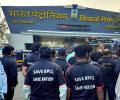
Oil Minister Hardeep Singh Puri on Thursday indicated that the much-delayed privatisation of oil major BPCL may not happen in the near future, saying there is "no proposal whatsoever" on his table for now. As part of its asset monetisation plan, the government had in November 2019 put Bharat Petroleum Corporation (BPCL) on the block and said it would completely sell its 52.98 per cent stake in the country's second largest state-run oil refiner and marketer. Though it had received three tentative bids, it got only one financial bid from Vedanta group, forcing it in May 2022 to shelve the plan pending a "comprehensive review".
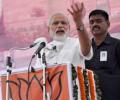
In a first, Prime Minister Narendra Modi on Wednesday met the secretaries of all the government departments collectively and asked them to directly get in touch with him to resolve issues and expedite decision-making.

To check fiscal deficit, government needs to drastically cut Plan expenditure.
The government will retain 51 per cent stake in all public sector units, finance secretary Ashok Chawla said. The government has proposed to mop up Rs 1,100 crore (Rs 11 billion) this fiscal from divestment of stake in PSUs.

FinMin finally sacked executive directors K V Brahmaji Rao and Sanjiv Sharan on January 18. The bank's board, however, had felt they had no criminal intent and it was a case of 'casual oversight'

Strengthening the portfolios of the home minister and the finance minister is a message that should not be missed, points out A K Bhattacharya.

'Inter-ministerial coordination, information on the proposed PSUs, and due diligence are taking longer than expected to conclude the process.'
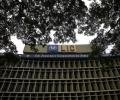
The government is working towards further review and simplification of the foreign direct investment (FDI) policy to facilitate the proposed initial public offering (IPO) of the Life Insurance Corporation (LIC), Department for Promotion of Industry and Internal Trade (DPIIT) secretary Anurag Jain said on Thursday. The final decision will be taken by the Cabinet. The industry department is working together with the finance ministry's department of financial services (DFS) and department of investment and public asset management (DIPAM) towards a successful listing of the life insurer on the domestic bourses, which is expected to be the largest in India.

Portfolios were on Tuesday allocated in the new Bihar cabinet headed by Chief Minister Nitish Kumar who, predictably, retained the all-important home department which helps him keep direct control on the state police.

If the fiscal deficit for the year can be maintained at Rs 7.04 trillion, the deficit as a percentage of GDP will slip to 3.44 per cent

Merely bringing down the government stake below 51% may not find any taker for the PSBs. The government must bring down its holding to at least 26%, recommends Tamal Bandyopadhyay.

These officers also have been divested of their current duties on charges of violating Rules 9 and 3(1)(xx) of the Central Civil Service Conduct Rules.

The New Year 2015, however, may see shares worth over Rs 50,000 crore (Rs 500 billion) being put on the table by the government, including by way of part-sale of its holdings in PSUs and its residual minority stakes in some private sector entities.

Arun Jaitley will aim for jumps in other revenue streams for the government.

The Centre's push to sell Air India on priority has led to delays in other strategic divestment proposals, such as privatising United India Insurance, as well as ongoing transactions, such as Shipping Corporation of India (SCI) and Bharat Petroleum Corporation (BPCL), revealed multiple officials involved in the process. The Department of Investment and Public Asset Management (DIPAM) is yet to take new privatisation recommendations of the NITI Aayog to the core group of secretaries on disinvestment (CGD) headed by the Cabinet secretary, said one of the officials. The priority now is to ensure all approvals for Air India are in place since the government intends to hand over the national carrier as early as this month.

'The target for next year is unlikely to be more than that of this year. The more you divest in any cycle, the less your potential pipeline for the next,' said an official. 'The first two issues we want to tackle and complete in FY20 are Air India and Hotel Ashok.'

The department of investment and public asset management is scouting for investment bankers and legal advisors to carry forward the transactions.
Unlike any other national asset, which is typically sold to the highest bidder, the profile of the bidder is the most important criterion for a licence to bank, and even for acquiring more than 5 per cent stake, explains Tamal Bandyopadhyay.
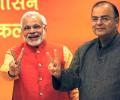
Reduce the government stake in public sector banks to 33 per cent, recommends A K Bhattacharya

They said that massive public investment in infrastructure, social sectors and agriculture would generate employment and the Union Budget should give it a priority and allocate necessary funds for this.

Tata Sons has emerged as the top bidder for the takeover of debt-laden State-run airline Air India but the bid is yet to be approved by a group of ministers headed by Home Minister Amit Shah, sources said.

Earlier this year, the Union Cabinet gave the management of state-run companies the freedom to decide on divesting their subsidiaries. However, the very next day a meeting was held at the top level of the Government of India, for the presentation of proposals for more autonomy for state-run companies. Interestingly, no chiefs of any of these companies were invited. It is a problem that will stare the government in the face with the state-owned banks too, as talks have again begun for inviting strategic investments in these companies.
Post-sale, the government stake would be 75 per cent, which will help NTPC to comply with the minimum public shareholding norms.

According to officials, more clarity might be required with regard to foreign fund managers in the context of Air India divestment.
 © 2026 Rediff.com - Advertise with us - Disclaimer - Privacy Policy - Sitemap - Feedback - About us - Terms of use - Grievances